By Darmon Richter
The first thing you should know is that Freemasonry is a big problem in Cuba.
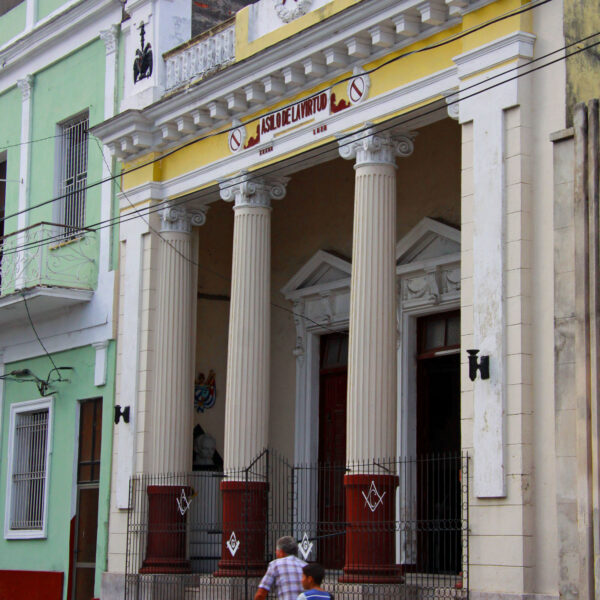
I was on a bus when I first noticed it, somewhere along the highway between Aguada de Pasajeros and Santa Clara. It was a hot, dusty day, and as the old vehicle puffed and puffed, I looked out the window and took in a rolling landscape of yellowing grass and palm groves, unfinished buildings, and, occasionally, a monument to the revolution with its flag waving. We passed through a town, its wide streets lined with the usual mix of Soviet-era concrete and colorful, crumbling Spanish colonial architecture. Suddenly, my eyes fell on a building that stood out from the rest, a burst of turquoise, red, and gold, more elaborate than anything else on the street. As the bus rattled past, I noticed the emblem carved in bold strokes above the front door: a square and compass, framed by a glorious burst of gold.
The sign immediately identified this as a Masonic lodge. These places usually do little to advertise their presence. In Western Europe, Masonic lodges tend to be more conservative affairs. They are often grand buildings, but discreet enough that their function isn’t apparent until you can make out their symbols and plaques. This Cuban hostel, on the other hand, was the most striking and colorful thing in town.
It was then that I remembered I was traveling through a communist state, and my brain did a somersault. Because, as far as I knew, Freemasonry had been outlawed by virtually every communist party in the 20th century. For example, the Grand Lodge of Yugoslavia was effectively dormant from 1940 to 1990. In Bulgaria , Freemasonry was banned by the 1940 Law for the Defense of the Nation, and subsequently, active and even former Freemasons were frequently accused of being agents of foreign intelligence services.
Freemasonry was outlawed in the Soviet Union as well, and although some of the leading communist revolutionaries had been members of Masonic lodges, they denounced the craft after seizing power in Russia. The general consensus seemed to be that such a system was incompatible with the new Marxist mode of society. However, as I gazed out the window of that damp, rattling bus, it appeared that Cuba disagreed.
That roadside hostel carnival wasn’t an aberration either, as I would discover during the rest of my stay in Cuba. Now that my eyes were open, I began noticing them everywhere, even collecting them. I saw the Logia Luz del Sur and Logia Aurora del Bien in Trinidad, on Cuba’s southern coast; Logia José Jacinto Milanés No. 21 in Matanzas; Logia Hermanos de la Guardia in Cifuentes; and Logia Asilo de la Virtud (the “asylum of virtue”) in Cienfuegos.
They dominated the city squares; they burst forth in colorful formations of pillars and plaster facades from otherwise simple village streets. Far from prohibiting Freemasonry, Cuba seemed to celebrate it. So, I decided to investigate a little and find out why.
Southern Light: A Brief History of Freemasonry in Cuba
The fact is that Cuba is home to a thriving Masonic community. In 2010, it was reported that the island had more than 300 Masonic lodges and over 29,000 active members. The fraternity first appeared there in 1763 and grew when French Freemasons fled the Haitian Revolution of 1791.
The first part of this story is not unusual. The former Caribbean colonies have long been a hotbed of Freemasonry. But the Grand Lodge of Cuba is notable because it flourished under a Marxist-Leninist dictatorship. One popular (though unverified) theory is that Fidel Castro may have been a Freemason.
When the revolutionaries landed in Cuba in 1956, the Castro brothers, Che Guevara, and the rest—all 82 of them—crammed onto a 12-berth yacht called the Granma . The island was under the tyrannical rule of Fulgencio Batista. History tells us that Castro and his brother were hidden from Batista’s forces by a small Masonic lodge in the Sierra Maestra mountains. It was from this remote lodge that Castro laid the foundations for his 26th of July Movement, which in 1959 would ultimately lead to the socialist revolution in Cuba.
Some say that Castro himself was initiated into Freemasonry during that time. Others suggest that only Raúl Castro, or some of the revolutionary fighters, were inducted. In any case, the supposed kindness and support shown to Castro during those years by a remote Masonic community fueled a popular theory about the tolerance that the Castro regime would later display toward Cuban Freemasonry.
It is certainly a good story, although the truth could be simpler; after all, Cuba already owed a great debt to its Freemasons. During the island’s struggle for independence from Spain, many of Cuba’s leading revolutionaries were proud Freemasons , including Carlos Manuel de Céspedes, Antonia Maceo, and the celebrated poet, journalist, and philosopher José Martí. It would have been extremely difficult for the regime to separate the memory of Cuba’s national heroes from the ideas they had openly celebrated.
“Afro-Cuban faith and Freemasonry… both played a role in building consensus after the revolution,” writes folklorist EC Ballard. “The former was useful in gaining the support of the island’s largely Afro-Cuban population, which remains poorly represented in government. The latter secured the sympathy of the Latin American left.”
As a result, Freemasonry in Cuba remained legal, although overseen by the Office of Religious Affairs. Membership increased after the fall of the Soviet Union, and the Castro government eased restrictions on the craft, allowing the opening of new lodges and even permitting Freemasons to participate in public ceremonies in full regalia.
Some aspects of Cuban Freemasonry stand out for their differences. In general, for example, the dress code for Freemasons in Cuba tends to be quite relaxed, and women are sometimes admitted to lodges. Ballard speculates that such adaptations are “generally welcome in a society that formally avoids prejudice and discrimination of any kind.”
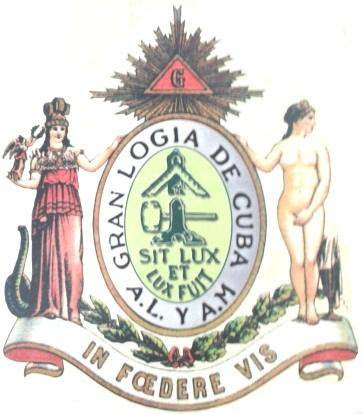
Today, more than a third of Cuba’s Freemasons are based in Havana, where the impressive Grand Lodge building dominates an entire city block, adorned with esoteric symbols. This is the heart of Cuban Freemasonry, the nerve center from which the 316 Cuban lodges are regulated; and after my week-long road trip through the southern cities, I was eager to pay it a visit.
The Grand Lodge of Cuba
Back in Havana, I spent a morning wandering through the city’s main cemetery, the Cristóbal Colón Necropolis. With rows upon rows of polished marble, the necropolis was founded in 1876 by the Spanish. As I made my way through the endless procession of whitewashed stone, I found a mass of esoteric epitaphs among the tombstones. Lodges gathered their dead, wrought-iron fences separating the deceased into memorial plots according to Masonic custom. The ship symbols were easy to spot.
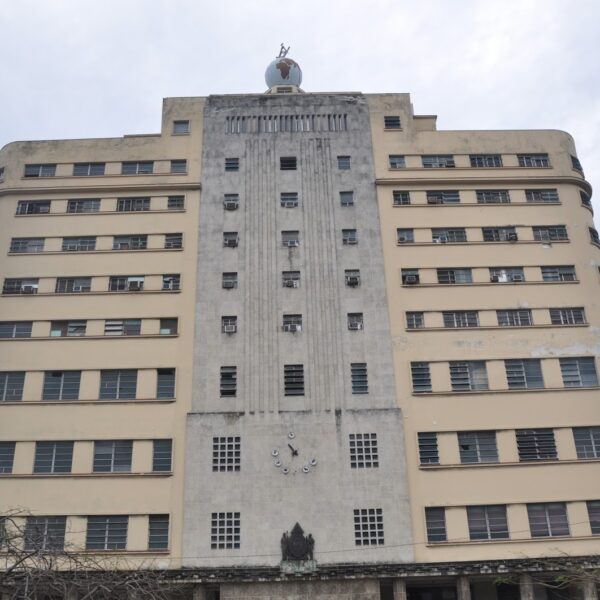
In the afternoon I set off for the Grand Lodge of Cuba at 508 Salvador Allende Avenue, an imposing 11-story structure that, before the appearance of a new wave of tourist hotels in the capital, was the second tallest building on the island. (The avenue itself is named after the thirtieth president of Chile, a Marxist, Freemason, and good friend of Castro.)
I spotted the Grand Lodge almost the moment I turned onto the avenue. I’d slid through narrow alleyways on my way there, under clotheslines and cobweb-strewn telephone wires, where kids played baseball in the street. And then, suddenly, there it was. Pontiacs and Corvettes rolled slowly down the avenue, while at the far end, towering above the colonial blocks and archways, a yellow titan pierced the horizon. It was as subtle as the cottages I’d seen, 11 stories of budget art deco topped with a globe, a square, and a compass.
Established in 1955, the Masonic headquarters in Havana contains the office of the Grand Secretary, a museum, a home for elderly Freemasons, and an extensive library (although, according to rumors, the Cuban government has since seized most of the floors for its own use). I approached, close enough to admire the zodiac clock on the building’s facade, but despite my best efforts, I was unable to enter.
A gentleman in a suit and glasses stood between the doors and greeted me with a mocking smile. I’d been told the library was open to the public. I gestured past him, into the building, and said, “Please?” while putting on my best smile. I was met with a polite shake of my head.
Not wanting to argue, I walked away, only to run into a man who had been watching the whole thing. The man was about 60 years old, with a sun-weathered face and the wiry build of a farm worker. I’d noticed him when I arrived at the park, raking leaves while smoking a cigar. “Hector,” he said with a mischievous grin, and shook my hand.
We exchanged jokes, and then I decided to jump over the fences. “Was Fidel Castro a Freemason?” I asked him. He laughed.
“Maybe,” he said, blowing a puff of smoke. “Who knows?”
“Hector,” I said, “are you a Freemason?”
Hector took a few thoughtful drags on his cigarette for a moment, his head half-lost in the clouds. “If I weren’t, I’d say no,” he replied. “But if I were, I’d still say no.” Then he laughed enigmatically, and I decided to leave it at that.