Originally published in The Skirret Vol. III No. 10 — October 1925
The long summer days are gone, autumn is here and the world takes up its tasks. The
judge returns to his bench, the preacher to his pulpit, the man of affairs to his desk
and the teacher to his/her school — the boys and girls following with no quick step.
To some it is a joy, to other a grind; but, all return to the work appointed them to do.
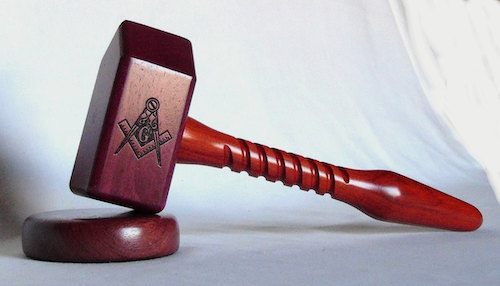
Last, but not least, the lodge is opened, tiled and tested; and the sound of the Gavel
in the East calls the Craft from refreshment to labor. Soon the noisy quarries will
be busy, making ready the stone for a living Temple slowly rising without the sound
of hammer or ax; built by the faith and labor of good and wise men as a shrine of
fellowship and a shelter for the Holy things of life.
The Common Gavel, it is a symbol both of labor and of power. As the square is no
doubt the oldest instrument of our science, so the Gavel is its oldest working tool —
some trace it back to the rude ax of the Stone Age. How simple it is — just a piece of
metal with a beating surface at one end and a cutting edge at the other, with a handle
for better effect in use. Every Mason knows by heart the explanation of its meaning,
given him in the First Degree:
“The Common Gavel is an instrument made us of by Operative Masons to break off
the rough and superfluous parts of stones, the better to fit them for the builder’s use;
but we, as Free and Accepted Masons, are taught to make use of it for the more noble
and glorious purpose of divesting our minds and consciences of all the vices and
superfluities of life, thereby fitting ourselves as living stones for that spiritual building,
that house not made with hands, eternal in the heavens.”
The words are simple; their meaning is plain — searching, too, when we think of the
rough and superfluous things which need to be broken off and polished away from
the best of us, before we are fit to be used by the Master of all good work. Alas, the
words are so familiar that we, too, often forget how pointed and practical they are,
teaching us the first necessity of the Craft — its need of clean and square men.
As we listen to those words for the first time, we did not realize how much meaning
they held. No one can. There are so many delicate touches in Masonry, so many fine
arts, that time is needed to see and appreciate them. Its business is to build men,
taking the raw stuff of us and shaping it into forms of beauty and use. Before us it
holds an ideal and plan of a Temple, into which it seeks to build our lives as stones. So
it begins by using the Gavel, cutting away rough edges and breaking off ugly vices. Any
man who knows himself at all knows how much it is needed, if he is to be a true man.
Nor did we notice, in the surprise of initiation, that the Gavel is also used by the
Master of the Lodge. With it he opened and closed the Lodge; with it he ruled. It is the
symbol of his power. It is wonderful, if we think of it, how the humblest tool is put
into the hand of the highest officer. So rough an instrument, the commonest in the
quarry, hardly seems to typify a ruler. Yet in the three principal offices of the Lodge it
is the symbol of authority. The Lodge is ruled not by a Square, still less by a Scepter,
but by the sound of a common Gavel — only Masonry could have thought of a thing
so beautiful.
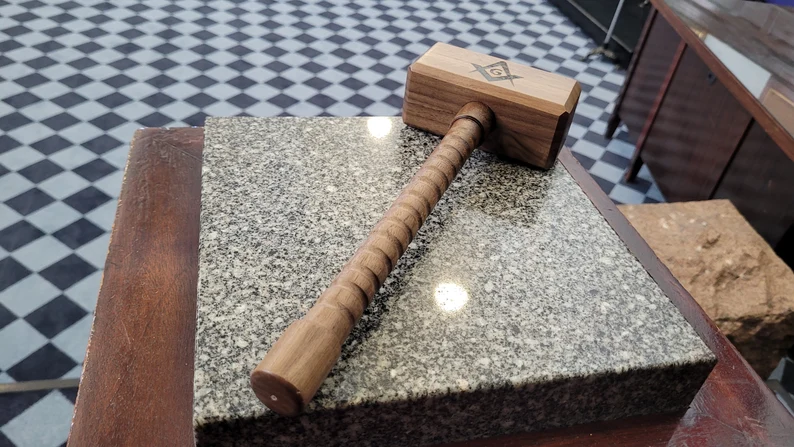
Nor it is to wondered at, because no tool in the kit of the Craft is used so often, and in
so many ways, as the gavel. Yet, as some one has observed, in all its variety of uses it remains the same. It is like a moral principle; it changes not. When the trough ashlar
is first taken from the quarry, the first tool applied to it, in the process of making it
fit for its place, is the gavel. Later, when the chisel must be used on the stone, the
Gavel — is employed to carry into effect the design of the worker. The Gavel is used
in breaking large stones, or for chipping off tiny fragments; and it is equally effective
for both ends.
While the Square, the Level and the Plumb has each one use and office, the Gavel is
used in many ways, either by itself or with other tools all the time. Cutting, chipping,
driving and setting it is always busy, always close to the hand of a Mason. Alike for
suppression and for construction,. its work never ends. It is the first tool of the
Craftsman, and the last he uses as Master of the Lodge, if he is counted worthy of that
honor by the merit of his labor and the trust of his Brethren. The Gavel is capable of
doing great work, or of spoiling good material; it is at once the test and the triumph
of a Mason.
So, naturally, the Gavel is an emblem of power. It is an emblem of the power for good
or ill in the hands of each man, being the commonest of tools; and also of the power
of the Lodge in the hand of the Master. If wielded roughly, it means ruin. If wielded
weakly, it means failure. If wielded wisely, and in the spirit of brotherly love, it is a
wand of magic and a scepter of good will. Man is tempted and tested by power as
by nothing else. Few are the men able to use it and not abuse it. No man is a Master
Mason, or fit to be the Master of a Lodge, until he has learned to use the Gavel with
dignity, self-control and gentle skill.
Since the Gavel is a symbol of the power both of Masons and of Masonry, it behooves
us to ask how it is being used. Is the Gavel only an emblem and nothing more, like
many another? Do we actually use it to cut away the vices and superfluities of life
which unfit us for the use and service of the Master Builder? Or, to put it otherwise, do
we take our Masonry seriously, as a way of learning noble ways of thinking and living?
Or is it a thing of rote, to be neglected when anything gets in its way — just another
order to belong to? In short, is Masonry the power it should be in our lives and in the
service of mankind?
As the Gavel sounds in the East, calling us to another year of Masonic Labor, each
of us ought to ask himself such questions as these, and answer them honestly in his
own soul. What kind of a Lodge would my Lodge be if all its members were like me?
What value would Masonry be to the world, if every one of its sons made the same
use of it as we do? Do we answer the signs and summons sent to us by the Lodge, as
we vowed to do at its Altar? If not, what is a Masonic Obligation worth, and what does
it mean — nothing? Such questions tell us where we are in Masonry, and why we do
so little with it.
Surely it only fair to ourselves, as well as to the Craft, to ask ourselves such questions
point blank. The Lodge opens on a new year, and we need to take stock of our Masonic
life and duty. What we lack more than anything else in America today, as citizens and
as Masons, is a sense of personal responsibility for our laws and institutions, which
enshrine the spirit and genius of our nation. If Masonry had a great place in the early
days of the Republic, it was because Masons gave it a great place by serving the nation
in its spirit. Truth wins if we are true to it and make it win.
Just now cynical writers in Europe are saying that American Democracy must fail —
that it cannot win. Of course it has not failed, else there would be more kings and more
slaves in the world. But American is still on trial, and it will win only in as so far as the
village church, and the Lodge over the store, become real centers of brotherly love
and neighborly cooperation and good will. When this sort of friendly and practical fellowship is abandoned by more than half of us, then our American Democracy will
fail and go to pieces, or else be only a shadow of itself.
Hear now some amazing facts which ought to make us ponder. Less than half of our
people ever attend, support or are in any way associated with any kind of church — a
fact to make a man stop and think, if he is aware of what happens to society when
the influence of religion fails or grows dim. Not less amazing is the fact that hardly
fifteen per cent of the Craft ever attend Lodge, or pay any heed to the sound of the
Gavel in the east. It is appalling, such sheer neglect, by indifference and carelessness,
of matters so vital to the well being of the nation.
The remedy, so far as Masonry is concerned, is not far to seek. It lies not far away,
but nearby, asking each of us to take a new vow in his own soul to make his Masonry
more real, more active, more in earnest both in his Lodge and in his life. Any other
way there is none, and it must begin with you and me. It is not Masonry that is at
fault, but Masons who forget and fail of their duty. It is time for each of us to take up
the common Gavel, the first tool of a Mason, and divest our own soul of its apathy,
ignorance, lack of zest and zeal.
What can we do to help the Master of our Lodge in the Masonic year now opening?
At least we can go to Lodge and be a worker in the quarry; and our presence will
increase, by so much, the influence of Masonry, and it will teach us to be helpers
in the encouragement of brotherly love and fellowship. No man knows how far a
simple act may go, gathering power as it goes. Our loyalty may be a tower of strength
to fifty men who otherwise may lose heart and fall away. Our faithfulness will be an
inspiration to the Master, who is human like ourselves, and pledged to bear many
burdens in his heart. If each does his part, the sum of our labor will be very great, and
the craft will increase in usefulness and power among men.
At the end of the day, when the lodge of our life is closed, and the sound of the
Gavel is heard no more, the one thing no man will ever regret is that he lived in the
fellowship of our gentle Craft, and labored in its service. Our life here amid sun and
frost has meaning to ourselves, and worth to the Master of all Good Work, only as we
invest such power as we have of light and leading to make the hard old world a little
kinder for those who come after us.
The New age stands as yet
Half Built against the sky,
Open to every threat
Of storms that clamor by.
Scaffolding veils the walls
And dim dust floats and falls,
As moving to and fro, their tasks The Masons ply.