Carl H. Claudy · Originally published in 1925
What makes a good leader? Is faithful service enough, or does leadership demand something more?
In this story, a young Freemason questions why a devoted member of his lodge has been passed over for promotion. Seeking answers, he turns to the Old Tiler, whose experience offers a different perspective on ambition, fairness, and the meaning of service.
About The Old Tiler Talks
First published in 1925, The Old Tiler Talks by Carl H. Claudy is a collection of short stories exploring Masonic values through conversations between a young Freemason and an experienced lodge officer.
The Tiler is responsible for guarding the entrance to the lodge during meetings, making him a fitting observer of its members and their concerns.
In Freemasonry, members may serve in various lodge offices, sometimes advancing through a traditional sequence of positions. However, advancement is not guaranteed, and leadership is intended to be a responsibility rather than a reward.
Written over a century ago, Claudy’s stories continue to invite reflection on character, brotherhood, and the principles of Freemasonry.
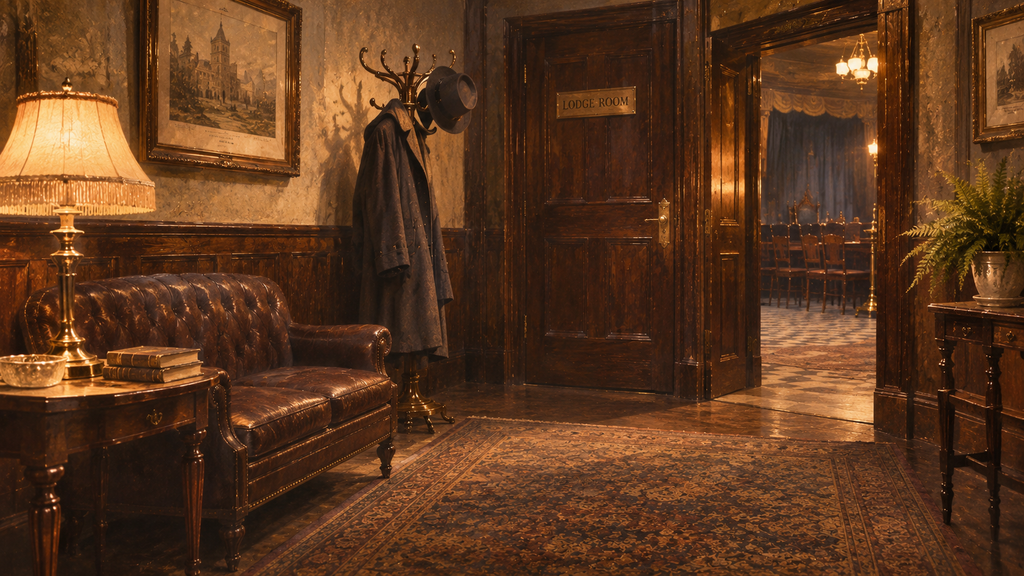
The anteroom of a Masonic lodge, where Claudy’s conversations between the Old Tiler and the New Brother take place
The Original Story: Promotion
Carl H. Claudy, 1925
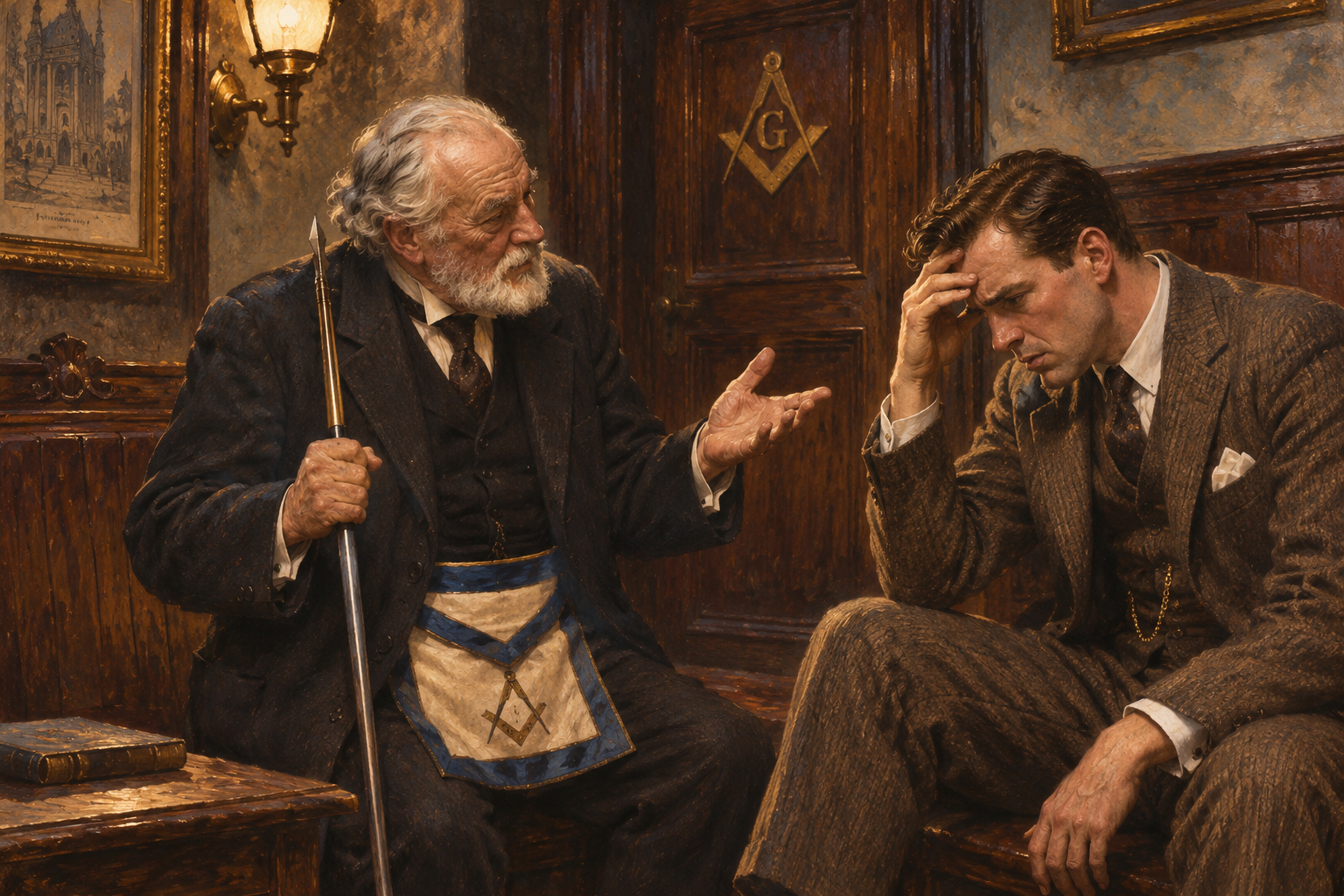
The New Brother’s face showed a bad case of peeve, and his voice reflected it as he greeted the Old Tiler in the anteroom.
“S’matter, son?” inquired the Old Tiler. “You look like a cross between a thunder cloud and the Black Hole of Calcutta!”
“Politics!” snapped the New Brother. “I thought it was bad form, undignified, un-Masonic to electioneer for officers. It’s bad enough any time, but when they electioneer for one who isn’t in line for promotion and to throw out one who has served years in the chairs, I think it’s terrible!”
“Yes, yes, go on,” encouraged the Old Tiler. “Get it all out of your system.”
“Tonight they elected Bill Jones Junior Warden. He doesn’t attend regularly, does he? And Smith, who was in line for promotion, was dropped. Smith never missed a night last year and did his best as Senior Deacon.
Jones is more popular than Smith, and may make a better officer, but the point is that Smith worked and Jones never has. So I’m peeved!”
“Wiser heads than yours have been peeved at politics in a lodge,” answered the Old Tiler.
“It’s a difficult question. By Masonic usage any electioneering is taboo. The unwritten law and the theory contend for a free choice of officers by unbiased votes.
But men are men first and Masons afterwards, and politics always have been played. I know of no way to stop a brother from telling another brother how he ought to vote!”
“That doesn’t dispose of the injustice of Smith,” answered the New Brother. “It isn’t right.”
“The majority thought it was right,” countered the Old Tiler. “Now that Jones has the job, I’ll tell you that I knew Smith wouldn’t get it.
He has been faithful to his work, never missed a night, done his best. But his best just wasn’t good enough.
You speak of Jones being more popular than Smith. There must be a reason, and if he is better liked he’ll make a better officer.”
“But it is still an injustice.” The New Brother was stubborn.
“You argue from the standpoint of the man who believes that a man elected or appointed to be Junior Steward has a neck-hold on the job ahead of him,” answered the Old Tiler.
“According to your idea any Junior Steward who attends lodge and does his work ought to be elected to the succeeding position each year as a reward of merit.
Actually, the job, not the man, is important. The good of the lodge is more important than the reward for the man.
“You don’t realize that Masonry is bigger than the individual, that the lodge is bigger than its officers, that the positions in line are greater than the men who fill them.
“A Master may make or mar a lodge. If he is a good Master, well-liked, popular, able, attentive to his duties and enthusiastic in his work, the lodge goes forward.
If only enthusiasm and faithfulness recommend him and he lacks ability, and the respect and liking of his fellows, and he has not the equipment to rule, the lodge will go backwards. Smith is a nice fellow, faithful, enthusiastic.
But he has more from the neck down than from the ears up. Jones hasn’t attended lodge much, but he is a brainy man, accustomed to preside, knows men and affairs, and, if he bears out the judgement of the brethren, will carry this lodge to new heights.
“Smith was given his chance for four years. In that time, he could not demonstrate to the satisfaction of his brethren that he would make a good Master.
It was a kindness to drop him now and not let him serve two more years. It is hard to be told ‘we don’t want you,’ but the lodge showed wisdom in choosing as Junior Warden a man in whom it believes, rather than merely rewarding faithful effort.
“I am sure the Master made a nice speech to Smith and thanked him for his work. His brethren will show him they like him as a brother if not as a Junior Warden. Smith will not be as peevish about it as are you.
He has been a Mason long enough to know that the majority rule is the only rule on which a Masonic lodge can be conducted.
He won’t understand his own limitations or believe he couldn’t be as good an officer as Jones, but he will bow to the decision of his fellows and keep on doing the best he can. That is Masonry at its best.
Politics is often Masonry at its worst, but in the long run the right men get chosen to do the right work.
Sometimes it is a bit hard on the man, but the good Mason is willing to suffer for the love he bears his mother lodge.”
“As a peeve-remover you are a wonder!” smiled the New Brother. “But I wonder how you’d like to be supplanted by another Tiler?”
“When the lodge can find a better servant, I shall be glad to go,” answered the Old Tiler simply. “I try to be a Mason first, and an Old Tiler afterwards!”
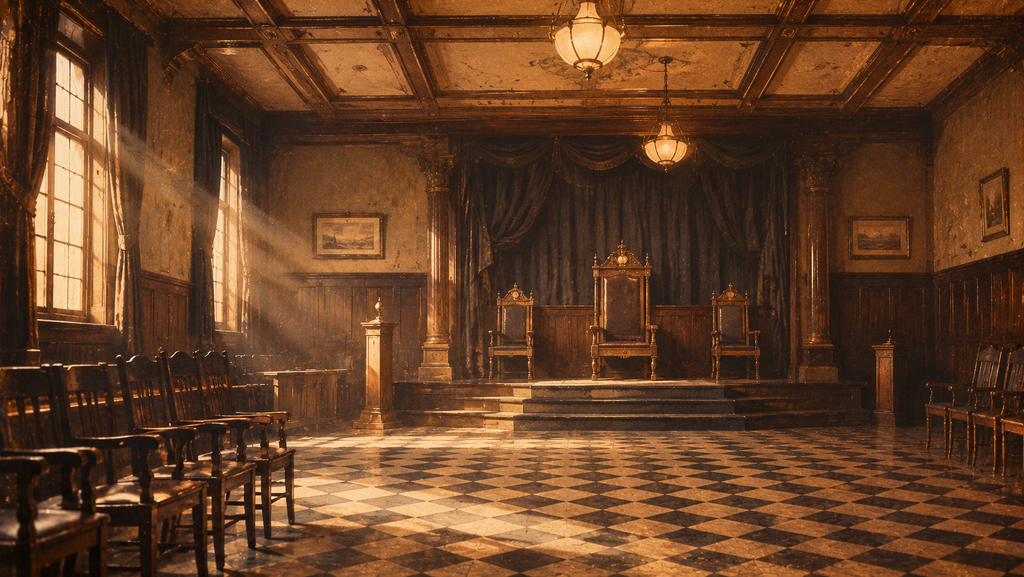
Leadership in Freemasonry is a responsibility to the lodge and its members, rather than a personal reward.
A Masonic Reflection: Leadership Is Service
Claudy’s story raises a question that extends far beyond Freemasonry: Should leadership be earned through dedication, or entrusted to those best suited to lead?
The Old Tiler reminds us that the good of the lodge must come before individual ambition. Leadership is not a reward for years of service, but a responsibility to others.
Yet his reasoning invites reflection. Is popularity always a sign of ability? How should faithful service be recognized? And what responsibility does a lodge have to develop its future leaders?
Freemasonry teaches that a man’s character matters more than his title. Whether serving as Master, supporting his brethren, or contributing quietly behind the scenes, every Mason has something valuable to offer.
Perhaps the story’s most enduring lesson lies in the Old Tiler’s final words:
“I try to be a Mason first, and an Old Tiler afterwards!”
The office is temporary. The principles we strive to live by should endure.
Questions for Reflection
What matters most in a leader: dedication, ability, character, or popularity?
How should an organization balance recognition of service with the need for effective leadership?
Can someone be an exemplary Mason without ever holding an office?
Discover Freemasonry
Freemasonry brings men together through brotherhood, personal improvement, and service to others. Its traditions encourage members to reflect upon their character and the responsibilities they hold within their communities.
Curious about Freemasonry?
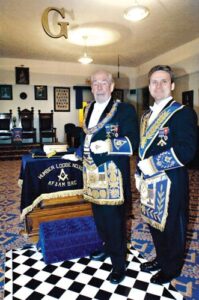
Humber Lodge No. 305 welcomes inquiries from men interested in learning about the fraternity, its values, and its traditions.
Learn more or get in touch at TorontoMasons.ca.
Historical note: Originally published in 1925, Claudy’s story reflects the language and perspectives of its time. The accompanying reflection is a modern interpretation, not an official statement of Masonic doctrine.
Source: Carl H. Claudy, The Old Tiler Talks (1925).